



Born Eco, Indian Cricket Explained From The Ground Up
Indian cricket is usually explained from the top down, starting with the national side and working backwards. This site does it the other way round, because almost everything that matters happens before a player is picked.
Born Eco covers four things: the domestic game, the academies that feed it, the board that runs it and the kit people actually buy. Each one is explained properly, with the fees, formats and rules written out rather than assumed.
What This Site Covers
The four sections are not arbitrary. They follow the route a player actually takes, and the route a supporter takes when they start paying attention to anything below the international game.
Domestic Cricket
The Ranji Trophy is the competition that decides most Test selection in India, and it is the one least understood by people who follow only the international side. The format has changed repeatedly, the points system rewards things that are not obvious from the scoreboard, and the promotion and relegation structure between the Elite and Plate divisions means a season can matter enormously to a team that will never win the title.
This section explains how the competition is built, what the points actually reward, and why established internationals drop back into it during a season.
Academies And Coaching
Most Indian cricketers come through a private academy before they come through a state system. Academies vary enormously in what they charge, what they provide and how honest they are about a child’s prospects.
We write these up with the figures included. Fees, age groups, session lengths, coach to player ratios and the admission process, because a parent choosing between two centres needs numbers rather than adjectives.
Inside The BCCI
The board controls selection, facilities, contracts and the domestic calendar. Its decisions reach every level of the game, and most of them are made in public documents that very few people read.
This section covers the structures rather than the personalities: what the Centre of Excellence in Bengaluru replaced and what it does, how the head coach role is defined, and where selection authority actually sits.
Kit And Gear
Equipment guides are usually written to sell something. Ours are written to explain what the differences between two products actually do on the field, and when a cheaper option is the correct one.
Sizing, materials, construction and care, with the trade offs stated plainly.
The Structure Of Indian Cricket, In One Table
Before any of the detail makes sense, it helps to see the levels side by side. A player moves up this ladder, and each rung is run by a different body with different rules.
| Level | Who Runs It | Main Competition | What It Decides |
|---|---|---|---|
| Academy | Private or club | Local leagues | Basic technique and exposure |
| Age group | State association | Under 16 and Under 19 | Entry to the state system |
| Under 23 | BCCI | Col. C.K. Nayudu Trophy | Readiness for senior cricket |
| Senior state | BCCI | Ranji Trophy | First class record and Test claims |
| Zonal and invitational | BCCI | Duleep Trophy and Irani Cup | Selection against stronger fields |
| International | BCCI and ICC | Tests, ODIs and T20Is | National selection |
Two things are worth noticing. The first is how many separate bodies a player passes through, each with its own selection committee. The second is that the Ranji Trophy sits at the point where private coaching stops mattering and recorded performance starts.
How The Ranji Trophy Season Works
The season splits into a league phase and a knockout phase, with a long mid season break while the limited overs competitions run. Teams sit in either the Elite division or the smaller Plate division, and movement between the two happens at the end of each season.
The league phase is where most of the season is decided, because group position determines whether a team reaches the quarter finals at all. A side can play well for four matches and still miss out, because the points system rewards outright victories far more heavily than good draws.
That shapes how captains play. A team that cannot force a result will often settle for the first innings lead, which is worth three points against six for an outright win. The gap between those two numbers explains most of the declarations you see on the third afternoon of a match that looks dead.
What An Academy Can And Cannot Do
Academies are the part of the system where families spend real money, and the part where claims are hardest to check. It is worth being clear about what the good ones provide.
A good academy provides volume and feedback. A child gets a large number of deliveries in controlled conditions, and somebody watches what happens and corrects it. That is genuinely valuable and it is difficult to get any other way in a city.
What an academy cannot provide is match cricket against stronger opposition, which is the thing that actually develops players once the basics are in place. The better centres acknowledge this and push their students into club and district cricket early. The weaker ones keep everyone inside the academy, where the fees are.
Three questions separate the two. How many of your students played district cricket last season? Who coaches the youngest group, the senior coach or an assistant? And what happens, concretely, if my child is not good enough?
Reading Fees Properly
Published academy fees are rarely the full cost. The advertised figure usually covers coaching sessions only, and several other costs arrive separately through the year.
| Cost | Usually Included | What To Ask |
|---|---|---|
| Coaching sessions | Yes | How many per week, and how long is each one |
| Ground and net hire | Sometimes | Is net time charged separately in peak season |
| Registration or admission | No | Is it annual or one time |
| Kit and uniform | No | Must it be bought through the academy |
| Match fees and travel | No | Who pays for away fixtures |
| Residential charges | Separate | What the boarding fee covers beyond a bed |
Ask for the total annual figure in writing rather than the monthly coaching fee. The difference between the two is often substantial, and a centre that will not put it in writing has told you something useful.
Where The BCCI Actually Sits
People talk about the board as though it were a single decision maker. In practice it is a federation of state associations with a professional staff, and authority is split in ways that matter.
Selection for India sits with a senior selection committee, not with the head coach, though the coach has input and in practice considerable influence. The domestic calendar is set centrally. Player contracts and central retainers are a board matter. Facilities and age group cricket are largely run by the state associations, which is why standards vary so much between states.
The Centre of Excellence in Bengaluru is the part of the structure that touches individual players most directly. It handles rehabilitation from injury, strength and conditioning work and specialist camps, and a player’s route back from a long injury runs through it rather than through their state.
Buying Kit Without Wasting Money
Cricket equipment is sold on brand and on marginal technical claims, and both are mostly noise below the professional level. A small number of things genuinely matter.
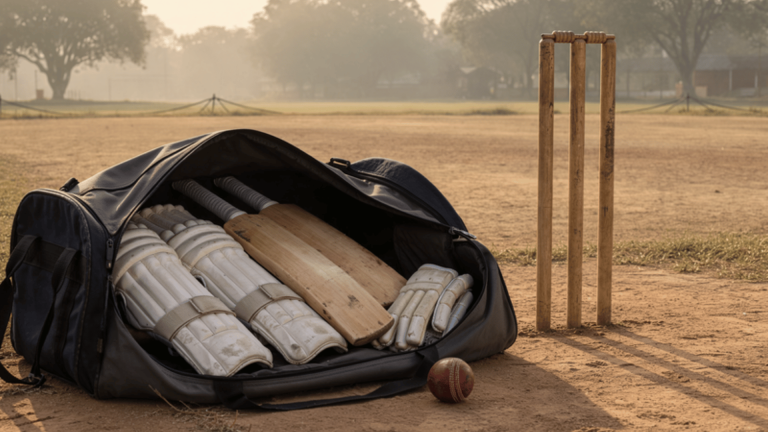
Fit matters more than specification in every category. A bat that is slightly too heavy will change a young player’s technique permanently. Gloves that are half a size too large will cost catches. Pads that are the wrong length will slow running between the wickets. None of that is fixed by paying more.
After fit, the question is how much use the item will get. A player who bats twice a week needs a different bat from one who nets daily, and spending heavily on a junior bat that will be outgrown in a season is poor value regardless of how good the willow is.
Protective equipment is the exception. Helmets, boxes and keeping inners are worth buying properly, because the failure mode is injury rather than inconvenience.
The Domestic Calendar, And Why It Is Crowded
India runs more domestic cricket than any other country, across every format and several age groups, and all of it has to fit around an international schedule that takes the best players away for most of the year.
The consequence is a calendar that stacks competitions rather than spacing them. The red ball season is interrupted rather than continuous, which is why the Ranji Trophy has a long gap in the middle. Limited overs tournaments run in that gap, and age group competitions run alongside both.
For a state player this means switching formats repeatedly within a season, often with a few days between a four day match and a fifty over game. For a supporter it means the competition you are following disappears for two months and comes back with the table unchanged.
How Selection Actually Happens
Selection is the part of the system people argue about most and understand least. It runs through several committees, each picking for a different level.
A state selection committee picks the Ranji side, usually from players already in that state’s system. A junior committee picks age group teams. A zonal committee picks for the Duleep Trophy. The senior national committee picks India squads, and it selects from a pool shaped entirely by what happened at the levels below.
This is why a player with strong first class numbers can still be overlooked. The national selectors are choosing between players they have watched in specific matches, often on specific surfaces, and raw averages across a career compress all of that into a single figure that hides it.
It also explains why a returning international playing one Ranji match is a significant event. It is a selection signal as much as a fitness exercise, and both the player and the selectors understand it that way.
What We Do Not Do
There is no live scoring on this site, no match reports and no transfer or squad speculation. Plenty of places do those well and quickly, and we would be a slower version of them.
We also publish no betting content of any kind. No odds, no tips, no previews written to inform a wager.
And we do not rank academies into a league table. Academies serve different students at different levels, the honest comparison is between a specific child’s needs and a specific centre’s offering, and a numbered list would imply a precision that does not exist.
How We Handle Figures And Dates
Fees, formats, points systems and schedules all change, often between seasons and sometimes mid season. Every article here carries the month it was last checked, so you can see how old the information is before you rely on it.
Where a figure comes from a published document, such as the BCCI’s playing conditions, we say which rule it sits under so you can check it yourself. Where a figure comes from an academy, it is what that academy publishes, and we say so rather than presenting it as verified.
If something here is out of date, the contact page explains how to tell us. Corrections are made on the page rather than quietly.
Where To Start
If you follow India but have never watched domestic cricket, start with the Ranji Trophy explainer. It is the competition everything else refers back to, and once the format and the points make sense the rest of the structure falls into place quickly.
If you are a parent working out where to send a child, start with the academy pieces and read the fees section above first, because it will change the questions you ask on a visit.
If you are buying equipment, the gear guides are written to be read before you go to a shop rather than after.
Red Ball And White Ball Are Different Jobs
A lot of confusion about Indian selection comes from treating first class form and limited overs form as the same currency. They are not, and the domestic structure keeps them deliberately separate.
Red ball cricket asks a batter to occupy time and a bowler to sustain accuracy across long spells on surfaces that change over four days. White ball cricket asks for scoring rate, defined roles and skills that only appear under fielding restrictions. A player can be excellent at one and unremarkable at the other without either judgement being wrong.
| Format | Main Competition | What Selectors Look At | Typical Career Signal |
|---|---|---|---|
| First class | Ranji Trophy | Runs per innings, overs bowled, second innings output | Test claims |
| List A | Vijay Hazare Trophy | Strike rate by phase, death bowling | ODI claims |
| T20 | Syed Mushtaq Ali Trophy | Role clarity, matchup performance | T20I and franchise interest |
| Under 23 first class | Col. C.K. Nayudu Trophy | Temperament over long innings | Entry to the senior state side |
Note that the Col. C.K. Nayudu Trophy uses a different points system from the Ranji Trophy, with additional batting and bowling points that the senior competition does not award. People regularly quote one table’s rules when discussing the other, and it is the single most common factual error in domestic cricket writing.
Why State Standards Vary So Much
The gap between the strongest and weakest teams in Indian domestic cricket is wide, and it is largely structural rather than a matter of talent distribution.
Three things drive it. The first is the number of turf wickets available in a state, which sets how much proper practice is possible. The second is the depth of club cricket, which determines whether a young player gets competitive matches every week or only in season. The third is money, because state associations fund their own age group programmes and the budgets differ enormously.
This is why the Plate division exists and why promotion from it is a genuine achievement rather than an administrative formality. A side coming up is usually doing so on the back of several years of investment in facilities, not a single good season.
It is also why a title won by a state outside the traditional group matters more than the scoreline suggests. It indicates that the structure underneath has changed, and those changes tend to persist.
Common Misunderstandings
A few ideas come up constantly and are worth correcting here rather than repeating in every article.
- The IPL replaced domestic cricket. It did not. Test selection still runs almost entirely through the first class game, and the two competitions sit in different parts of the calendar.
- A draw is a wasted match. In the Ranji Trophy a first innings lead in a drawn game is worth three points, which is often the difference between qualifying and not.
- Academies guarantee progression. No academy can supply competitive match cricket at the volume a developing player needs. The good ones push students outwards into club and district sides.
- The head coach picks the team. Selection sits with a selection committee. The coach has input and influence, which is not the same thing as authority.
- Expensive kit makes a better player. Fit determines almost everything below professional level. Protective equipment is the one category where paying properly is straightforwardly worth it.
Each of these has an article behind it on this site, with the detail and the source of the rule set out.